

A material that keeps earning its place
Cork has a way of quietly reappearing in places where performance, workability, and durability matter. It’s rarely the loudest material in the room, and it doesn’t arrive with the fanfare that beautiful cedar planks or buzzword-heavy recycled plastics do. But once you start putting it to work, it quickly earns its place in the shop. For us here at Grain, cork has resurfaced time and time again—from our very first boards—and it’s become one of those materials that continues to make sense the more we use it.

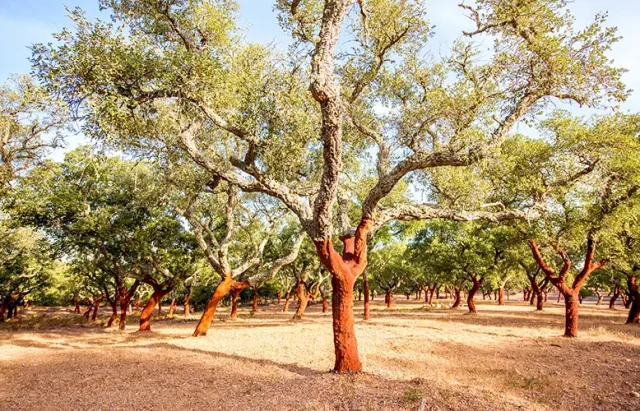
Most people’s relationship with cork starts casually—a wine bottle, a pinboard, maybe a pair of sandals or a yoga block. It’s familiar in a way that makes it easy to overlook. But cork has a rich story of its own. Cork is harvested from the bark of the cork oak, Quercus suber, a tree native to the western Mediterranean. Portugal is the world’s largest producer, with Spain, Morocco, southern France, and parts of Italy also forming part of what’s often referred to as the cork belt. These landscapes aren’t monoculture plantations—they’re living ecosystems that support biodiversity, agriculture, and long-standing cultural practices tied directly to the health of the trees themselves.
What truly sets cork apart is how it’s harvested. The trees aren’t cut down. Instead, skilled harvesters—often a trade passed down for generations—strip the bark by hand every nine to twelve years, allowing the tree to regenerate naturally. Over time, the bark actually grows back thicker and stronger, and the trees themselves can live for well over two centuries. In fact, cork oaks absorb more carbon dioxide during the regeneration process than they do when left untouched. It’s one of the rare materials where use and renewal are not in conflict, but fundamentally linked.
On a structural level, cork’s performance comes from its cellular makeup. It’s composed of millions of microscopic, air-filled cells that give it a combination of properties that are difficult to replicate synthetically. Cork is lightweight but resilient, compressible yet durable, able to absorb energy and rebound without fatigue. It resists moisture, rot, and degradation, and it performs consistently over time under repeated stress. Much like surfboard design, these characteristics aren’t accidental—they’re the result of evolution, refined over thousands of years.
Because of that, cork has found its way into applications that demand reliability. It’s used in aerospace as thermal insulation, where materials must withstand extreme temperatures and pressure. Architects and builders use cork for flooring because it’s durable and has excellent dampening properties. You’ll find it in fishing gear for flotation, in automotive components, sporting equipment, and even fashion. In each case, cork is doing the same job: absorbing impact, managing stress, and lasting longer than you’d expect.

Surfboards, it turns out, ask a lot of the same things from materials. They need to flex without failing, absorb impacts without deadening feel, and survive constant exposure to saltwater, sun, and repeated stress. That overlap is part of why cork keeps making sense to us—why we’ve kept taking it down off the shelf all these years.
At Grain, materials have always taken center stage. From the beginning, we’ve been driven by curiosity and a desire to work with our hands and use natural materials. That curiosity has led us to experiment with flax and hemp fibers, recycled plastics, bamboo, and repurposed woods and veneers. We’ve tested bio-based resins, natural oil finishes, and a wide range of adhesives—some of which worked beautifully and others that taught us important lessons.
We’ve gone further, too. We’ve explored seaweed-based materials, mushroom-derived foams, carbon fiber and basalt, and more experimental concepts that may or may not ever see the light of day. Some projects live behind NDAs. Others simply didn’t earn their place. That’s part of the process. Innovation isn’t about chasing the newest idea—it’s about understanding materials deeply enough to know where they belong and having the patience to get them there.
Cork is one of the materials that keeps passing that test. From a building standpoint, it’s forgiving, workable, and consistent. From a values standpoint, it aligns with how we think about environmental responsibility and longevity.

Progress isn’t always about inventing something new. Sometimes it’s about paying attention to where you’ve been, to your values, to what’s important and what really works—and letting that lead the way.